Introduction
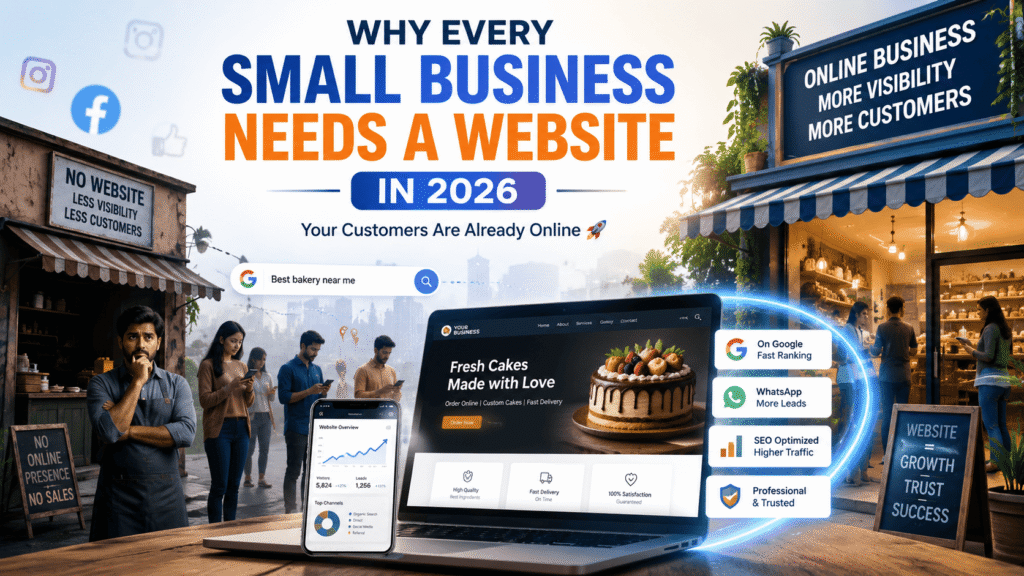
In 2026, a website is not optional but a foundational, cost-effective asset for small businesses, providing critical credibility, 24/7 visibility on search engines,
and a secure “digital front door” that builds trust over unreliable social media. It acts as a centralized hub for automation, lead generation, and customer engagement,
enabling small businesses to compete with larger competitors.
What is a Business Website?
A business website is an online “headquarters” that acts as a digital storefront, brochure, and salesperson, working 24/7 to represent a company, build trust,
and attract customers. At its simplest, a website is a collection of files (text, images, and videos) stored on a powerful computer called a server.
How a Website Works:
Think of visiting a website like calling a pizza place:
You (The Client/Browser): You type the web address (e.g., ://yourbusiness.com) into your browser (Chrome, Safari, etc.).
The Internet (The Road): Your browser acts like a courier, searching the internet to find where those files are stored.
The Server (The Kitchen): The server, which is a computer holding the website files, acts like the pizza kitchen. It receives the request and sends the website files back to your browser.
The Display (The Pizza): Your browser receives these files and turns them into the visual website you see on your screen.
Speed: This whole process happens in milliseconds.
Key Components of a Business Website:
Every website needs three main things to exist:
Domain Name (The Address): This is the human-readable address people type to find you (e.g., yourbusiness.com).
Web Hosting (The Land/Storefront): This is the space you rent on a server to store your website files. Without hosting, your site isn’t live.
Website Files (The Store): These are the actual pages, images, and content that make up your site.
Key Elements of a Successful Business Website:
A good business website should do more than just exist—it needs to work for you:
Clear Navigation: A simple menu so customers can find information easily.
Call-to-Actions (CTAs): Buttons or links that guide visitors to act, like “Buy Now,” “Call Us,” or “Book an Appointment”.
Trust Signals: Testimonials, reviews, and a clear “About Us” page.
Mobile Responsiveness: It must look good on phones, not just computers.
Contact Info: A contact form, phone number, or map.
Why Small Businesses Need a Website
Builds Trust and Credibility
A website builds business trust through professional, secure, and transparent design that showcases social proof (reviews), humanizes the brand, and provides
easy navigation. Key elements include SSL security, clear contact info, real photos of the team, and fast loading speeds to signal reliability and legitimacy.
Website credibility is crucial for small businesses because 75% of consumers judge a company’s legitimacy based on its website design. A professional site builds trust,
showcases expertise, and acts as a 24/7 digital storefront to convert visitors into customers. Without one, businesses risk looking illegitimate, outdated,
or losing customers to competitors.
24/7 Availability
A 24/7 website acts as a continuous, automated sales and marketing tool that works without breaks, allowing businesses to generate leads, process sales, and provide
information, such as through Wix or other platforms, anytime—even while sleeping. It increases customer convenience, expands market reach across time zones, enhances
credibility, and offers a competitive edge by staying accessible when physical locations are closed.
Reach More Customers
Websites help reach more customers by acting as a 24/7 digital storefront, dramatically increasing visibility beyond local limitations. They enable customers to find
businesses via search engines (SEO), build credibility through professional branding, and foster engagement through content marketing and online, mobile-responsive
experiences.
Better Marketing Opportunities
A website is the central hub for online marketing, acting as a 24/7 digital storefront that builds credibility, drives sales, and establishes brand identity. It acts
as the destination for traffic from SEO, social media, and paid ads, allowing businesses to showcase products, generate leads via forms, and analyze visitor behavior
to optimize marketing strategies.
Full Control Over Your Business
A website provides full ownership and control, acting as a stable, branded digital headquarters that ranks on search engines. Conversely, social media is a rented
space driven by algorithms, ideal for engagement but subject to sudden visibility losses. A website is crucial for trust and conversions; social media excels at
reaching new audiences fast.
Key Benefits of Having a Website
A website provides small businesses with a 24/7 digital storefront that builds credibility, increases visibility through search engines, and attracts new customers.
It serves as a cost-effective marketing tool to showcase products, gather customer data, and compete with larger companies.
Key Benefits of a Website for Small Businesses:
24/7 Online Presence:
Customers can find information, browse products, or contact you anytime, even outside business hours.
Credibility & Professionalism:
A website makes a business look more legitimate and trustworthy than relying only on social media.
Increased Visibility (SEO):
Optimized websites allow businesses to appear in search engine results (e.g., Google) when customers search for services, increasing lead generation.
Brand Building:
A dedicated site allows you to showcase your brand identity, share your story, and display customer testimonials and reviews.
Cost-Effective Marketing:
Websites are cheaper than traditional advertising (flyers, print ads) and offer better targeted reach.
Enhanced Customer Service:
You can provide FAQs, support, and contact forms, saving time on customer queries.
Showcase Products/Services:
Acts as a virtual catalogue or portfolio to display offerings to a wider audience.
Valuable Data & Analytics:
Tools like Google Analytics allow you to understand visitor behavior, helping to refine marketing strategies.
Competitive Advantage:
A professional site helps you stand out from competitors who may not have a solid online presence.
Common Mistakes Small Businesses Make
Small business websites often fail to generate leads and sales due to poor strategy rather than just poor design, with up to 90% failing to convert
visitors. Key reasons include invisible SEO, slow loading speeds, lack of mobile optimization, and unclear, weak, or missing calls to action (CTAs),
leading to high abandonment rates.
Top Reasons Small Business Websites Fail:
Invisible to Search Engines (Poor SEO):
Many sites lack a solid SEO strategy, making them impossible to find in search results. Targeting overly competitive, broad keywords rather than
specific local terms causes, for instance, a local plumber to fail against national competitors.
Slow Loading Speeds:
More than 53% of users abandon a website if it takes longer than 3 seconds to load.
Poor Mobile Optimization:
With over 60% of web traffic coming from mobile devices, a site that is not mobile-responsive fails to rank well with Google and drives users away.
Unclear Value Proposition & Weak CTAs:
If visitors cannot immediately understand what the business offers, they leave. 70% of small business websites lack effective call-to-action buttons,
missing crucial sales opportunities.
Poor User Experience (UX) & Navigation:
Cluttered layouts and hard-to-find information frustrate users, causing 88% of them not to return after a bad experience.
Lack of Trust Signals: A lack of clear contact information, client testimonials, or professional, consistent branding reduces visitor trust.
How to Fix Common Failures?
Optimize for Speed:
Compress images and use faster hosting to meet user expectations.
Prioritize Mobile:
Ensure the site is built mobile-first.
Create Clear CTAs:
Use prominent, clear, benefit-driven messaging (e.g., “Get a Free Quote” rather than just “Submit”).
Implement Local SEO: Target specific local keywords (e.g., “emergency plumber Hamilton”) to compete effectively.
Focus on Value: Clearly state what you do and who you serve above the fold (within the first visible screen).
Best Practices for a Successful Website
Create an effective business website by prioritizing a simple, fast-loading design with clear navigation and a professional, consistent brand image.
Key elements include a strong call to action (CTA) on every page, mobile-friendly responsiveness, and high-quality, engaging content that addresses
visitor needs.
Here are top tips to build a successful business website:
Essential Design & Structure:
Keep it Simple & Professional:
Use a clean, uncluttered layout with consistent fonts, colors, and branding.
Prioritize Mobile Responsiveness:
Ensure the design works flawlessly on all screen sizes, as mobile friendliness is crucial.
Intuitive Navigation:
Limit top-level navigation to around five items, ensuring visitors can find information quickly.
Fast Loading Speed:
Optimize images and use a reliable host to ensure pages load quickly, preventing visitors from leaving.
Core Pages Your Site Needs:
Homepage: Clearly states who you are and what you offer.
About Us: Builds trust by sharing your company story.
Services/Products: Details your offerings and value proposition.
Contact/Form: Easy-to-find contact details or a contact form.
Testimonials/Portfolio: Demonstrates social proof.
Real-Life Example (Pakistan Market)
Pakistan’s e-commerce sector is experiencing rapid expansion, with annual growth exceeding 20-35% and total sales projected to surpass PKR 300 billion
by early 2026. Driven by over 100 million broadband subscribers and rising smartphone penetration, key sectors include fashion, general merchandise,
and quick-commerce, while over 100,000 small sellers support a booming digital economy.
Top E-commerce Categories (2026):
Apparel/Fashion: Generates the highest sales ($1.05 billion).
Health & Beauty: Strong growth in personal care products.
Computers/Electronics: High transaction volumes in computing and accessories.
Trend Highlights: High-growth trending products include protein powders, headphones, face wash, and home goods like rugs and sofa covers.
FAQs
Does a Small Business Need a Website?
Yes, small businesses should have a website FAQ to improve user experience, boost search engine optimization (SEO), and reduce customer service time.
It addresses customer concerns—like pricing, shipping, and service details—24/7, reducing friction, building trust, and speeding up the conversion
process, ultimately allowing customers to self-serve.
Why Small Businesses Need a Website FAQ:
Improves Customer Experience:
A well-organized FAQ keeps visitors on your site longer and reduces frustration, preventing them from leaving to find answers elsewhere.
Boosts SEO and Discoverability:
FAQ content often matches search queries, allowing your site to rank higher and appear in Google featured snippets.
Reduces Support Burden:
An FAQ acts as a first-line support tool, reducing the time spent answering common, repetitive questions via phone or email.
Builds Trust and Converts Leads:
By answering concerns upfront—such as return policies or service areas—you remove buying barriers, helping visitors move from browsing to buying or
calling.
Establishes Credibility:
A comprehensive FAQ shows professionalism and transparency, making your business appear more reliable.
Provides 24/7 Service:
An FAQ answers customer questions even when the business is closed, which is particularly useful for users researching in their own time.
Conclusion
In 2026, a professional website is no longer a luxury for small businesses, but a fundamental necessity for survival, credibility, and growth.
As consumer behavior shifts overwhelmingly toward online research before purchasing, a website acts as your 24/7 digital storefront, establishing
trust and ensuring you remain competitive in a crowded, AI-driven market.